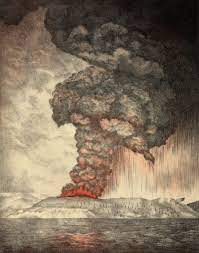
Mount Krakatoa eruption
By Elliot.
Introduction
Hello everyone, I'll be talking about Mount Krakatoa, one of the worst volcanic eruptions in history.
Where, when and what
The Mount Krakatoa eruption took place at Rakata Island in the Sunda Strait between Java and Sumatra, Indonesia on 20 May 1883. Heard 4828 km away, the explosions threw 8 cubic km of earth 80 km into the air. It also created 37 m tsunamis and killed 36,000 people.
Destructive force
A further point, Mount Krakatoa cooled the entire Earth by an average of 0.6'C for months to come. The Krakatau eruption had an explosive force of a 200 megaton bomb, while the biggest nuclear bomb only has 50 megatons. Mount Krakatoa was 813 m in elevation.
Records
Furthermore, 1883 was not the first time Krakatoa had erupted. In 1680, Dutch sailors reported seeing Krakatoa erupting. It last erupted in 2020. Also the Mount Krakatoa eruption holds the world record for loudest sound ever recorded at 172 decibels. But the "sonic boom" was the loudest sound on earth to happen which was estimated to be 235 decibels.
Rock
Pumice is a light volcanic rock formed when lava solidifies rapidly. In powder form it's used for smoothing and polishing. It is used in nail salons to remove dead skin on the feet. Pumice is light to medium grey in colour. This is a piece of pumice that I brought from home to show you.
Ending
Overall, Mount Krakatoa was one of the worst volcanic eruptions in history, throwing 8 cubic km of earth into the air, created high tsunamis and killed thousands of people. The Krakatoa eruption could be heard 4828 km away and had an explosive force of a 200 megatons bomb, 4 times more than the biggest nuclear bomb. The sound of the eruption was so loud that it burst eardrums.
References
Eruption of Krakatoa
The volcanic eruption of Krakatoa
Krakatoa
Definition of pumice
Science and geology about pumice
Sonic Boom
Link to Main page
Main page